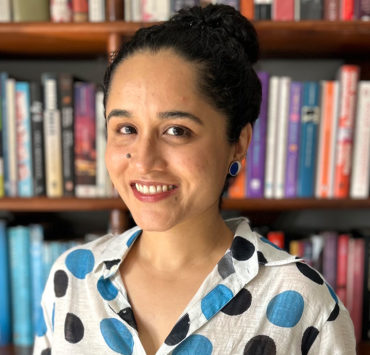




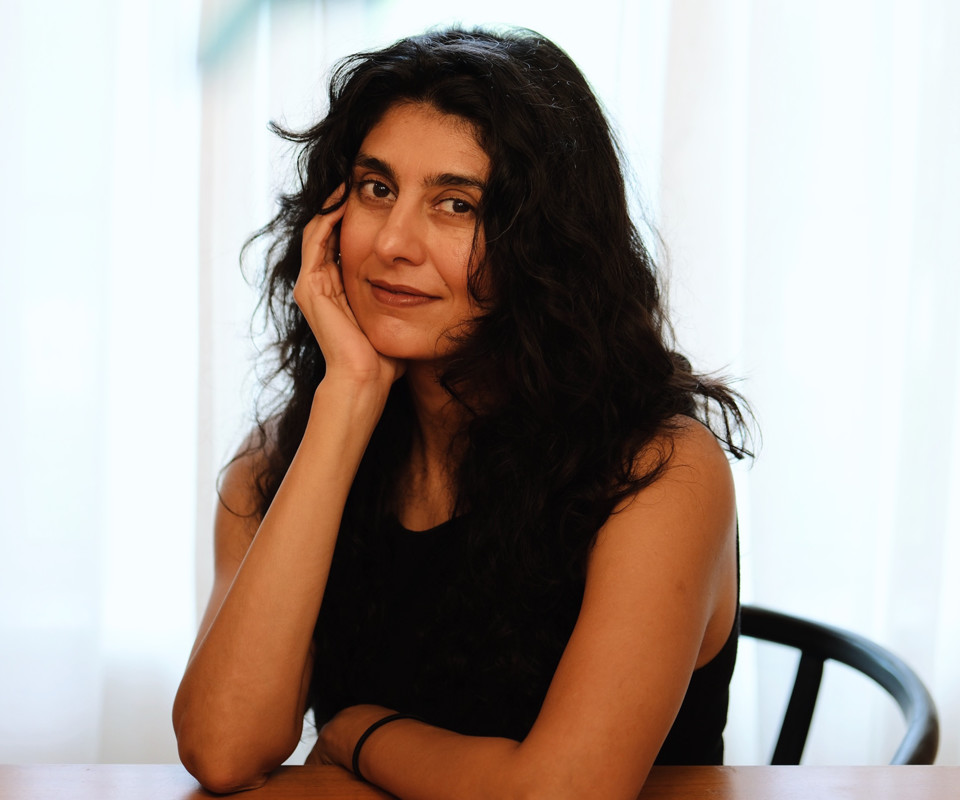
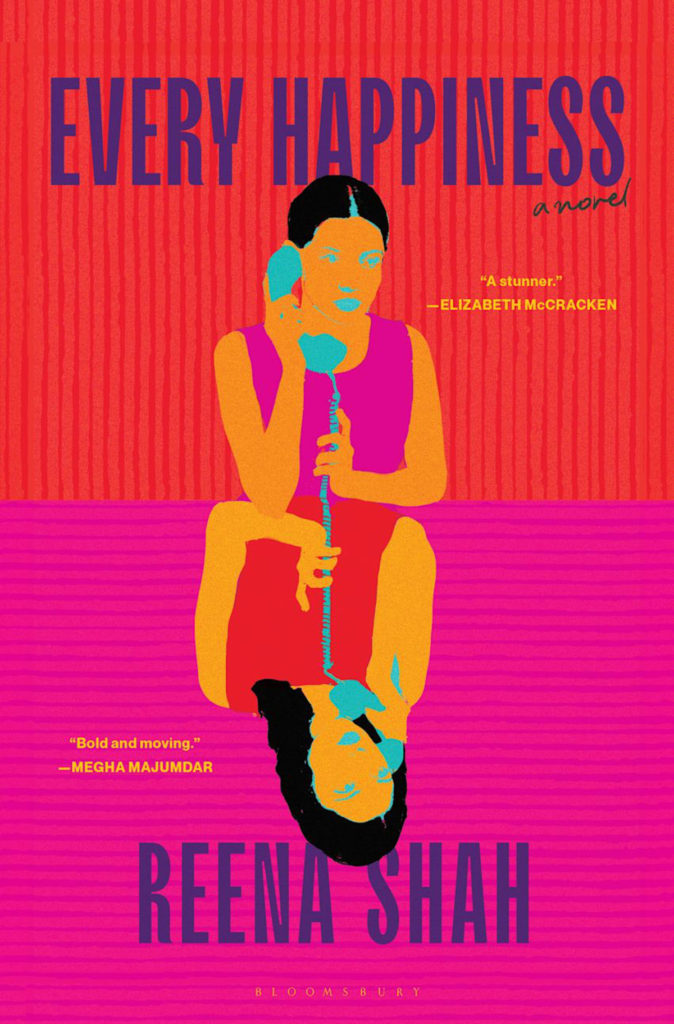
Every Happiness, Reena Shah’s debut novel, follows two close friends through decades of their lives. Ruchi and Deepa are drawn to each other instantly when they meet at a Catholic school at age 12, forming a bond that connects them through life. When Deepa marries and moves to suburban U.S.A., Ruchi follows swiftly. And as both of them navigate adult life—parenting, money, societal expectations—there is a distance that starts to grow between them, hidden by their closeness, that seems insurmountable. Their story is one of love, friendship, and desire. It is also a story of jealousy, competition, and repression.
Every Happiness is a moving, intimate, wide-ranging novel that invites us into the minds of its real, complicated, and three-dimensional characters. Reena Shah spoke to Helter Skelter in an exclusive interview about letting a novel grow, writing characters in confinement, and the importance of both faith and doubt for a writer.
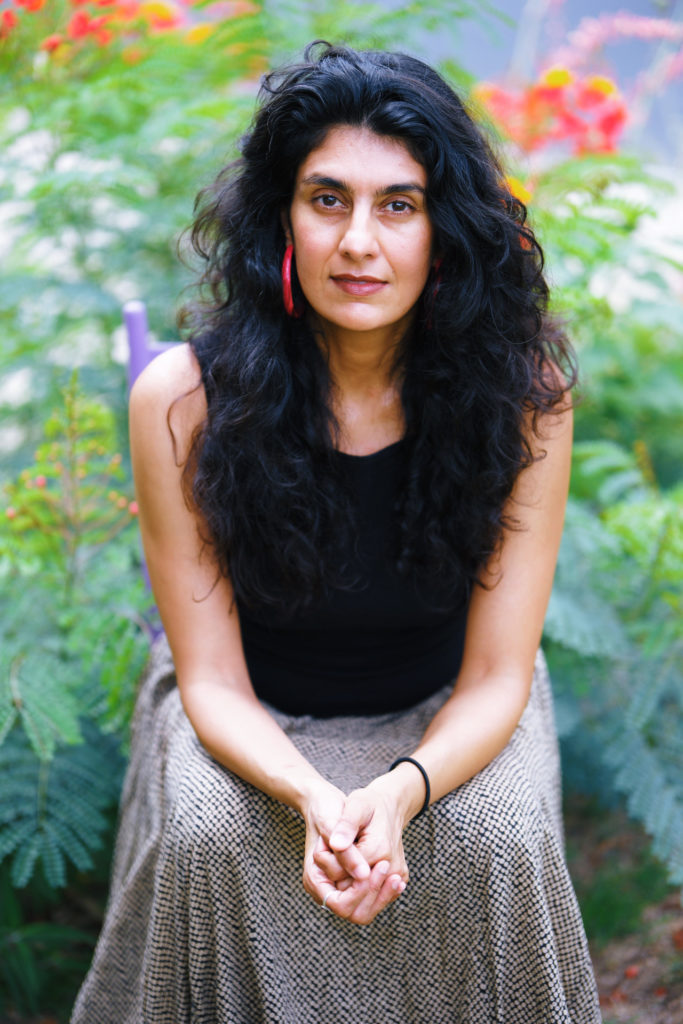
You’ve mentioned that Every Happiness started off as a short story, and then became a linked story collection. How did you go about taking it from that to a novel?
It took a lot of work. I didn’t have plans for this to be a novel. I didn’t think I knew how to write a novel; I thought I wasn’t ready, that I didn’t know what it means when you’re ready to write a novel.
And then the story grew. I started writing about more characters, and the second half of the book started becoming more like a novel, almost like there was a thread, despite my efforts to not have one. I think that’s because Ruchi and Deepa became more of the central story. My initial intention, or my initial impulse to write about these characters, was really about the relationship between Ruchi and Moksh—that mother-son relationship. As a writer, your characters, as they develop, become themselves, and they begin to lead the process. That’s kind of what happened.
It took me a long time. It took seven years to write from beginning to end. I know Kiran Desai’s last book took 20 years, so seven years sounds kind of average! But it feels like a long time to be working on one project. Once I had a draft, [it was really helpful] having readers who could help me see what I couldn’t see, especially in the first half of the book, which was more story-like. I definitely took some sections out because they were essentially short stories that were in the middle of the book. I couldn’t do it on my own, in a sense. I needed feedback to be able to see how to develop this into a novel.
I think I learned that you write a novel by writing it. There’s no apprenticeship, in a way. You think, Well, if I write enough short stories, I’ll learn how to write a novel [and that’s not true]. They’re very different. The short story is an incredibly difficult form. I don’t think it’s any easier than a novel. I think [part of the process was] accepting those kinds of uncertainties.
The relationship between Ruchi and Deepa is the crux of the novel. I thought it was such an interesting and complex relationship. There’s differences between them; there’s attraction. There’s desire, jealousy, competition. I think what struck me is how much all of that interacts with each other: there’s competition and care, and sometimes that’s in the same moment. And we’re following them through their lives, across decades. What was that relationship like to draw? How did you approach writing that complexity?
I love that you saw that—those moments are not separate. They can be in the same moment, all those feelings that they have. What seems like a moment of care can quickly become a moment of tension. The word ‘relationship’ also feels appropriate. I think I do think of them as having a friendship, but the word ‘friendship’ feels too light of a word for what we call friendship in general. It’s such a mysterious relationship. Friendship is entered into by choice. They’re strangers. They’re not part of your family. And what draws you to another friend?
I think it was also the generation, this generation of women I was very drawn to in this book. It’s the next generation above me, women that were born in the ’40s or ’50s and who came of age in the ’60s and ’70s, where they were contending with so many more limits on their behaviour and on their aspirations. I think about how they had to form themselves around those limits. That can warp your sense of yourself. And I think that happens to both Ruchi and Deepa—especially Deepa. Those pressures and those boundaries confine them in a way that the friendship becomes the place where they have to deal with those warped emotional selves. When Deepa is being unkind, or when Ruchi is filled with envy, it’s so much about themselves and how they are then projecting that on each other. It’s also a place where it’s safe to do so. They keep returning to this friendship. It’s a compulsion. It’s part of who they are, especially as they leave India and immigrate and they only have those memories of childhood with each other.
“I think I learned that you write a novel by writing it. There’s no apprenticeship.”
Emotions of love and care are really complicated. When we interact with other people, sometimes it’s so impossible to really know a person, [and with these characters] especially because they can’t say all the things they want to say. There’s so much fear of vulnerability. It’s ripe for misunderstanding or hurt or pain or jealousy, because they’re trying to interpret the other person with less material. They’re both, I think, very aggravating in that way. Sometimes, when I was writing, I would be like, Just say it! But that wouldn’t be true to who they were—the repression that, over years, had become so strong and that (without giving too much away) Ruchi really was trying to break out of.
I find how any relationship works such a mystery, because there’s so many ways in which it can go wrong. [Especially] when you don’t have ties of blood or it’s not a work colleague, where you don’t have to make it work. Sometimes we’re more careful in these relationships, but sometimes we’re not. We can’t help ourselves, maybe. With Ruchi and Deepa, they couldn’t help but feel all of those things at once.
It feels very real. I like what you said also about them not saying things to each other. In many ways, a lot of the time, they’re not saying it to themselves, either, which I thought was absolutely how people live.
You mentioned at the beginning that this started off as a mother-son story. I found the relationships between the kids and their parents—or the kids and each other’s mothers—very fascinating. I was wondering why you decided to not keep the story to one generation, but also how you approach writing these complicated relationships.
I really enjoyed writing the kids because they do communicate more. They are a generation that is free-er, even though they also have these boundaries that are placed on them—both by their mothers, but also by what’s expected of them, trying to live in this third culture and forging their way in in the United States. It’s very different from how their parents are approaching that.
I keep saying this: For the next novel, I’m going to keep it super simple. It’s not going to take place for sixty years. It’s not going to have all these perspectives. But I can’t control it. I think as a novel develops, it develops its own complexity. For Ruchi and Deepa, their children become almost a canvas upon which their own hopes and aspirations and fears are also played out.
I had read an interview with Kiran Desai—not to keep bringing up Kiran Desai!—where there was something about her saying, especially with narratives about South Asian families, the intergenerational aspect of the family is so, so critical; the generation above or below. I think she said something along the lines of, You can’t understand a love story between two people without understanding their parents. And I would say the same thing for Ruchi and Deepa. To understand them, you have to know their children as well, and how their relationships and their jealousies and their envies get played out in how they view each other’s children, and their judgements about how the other one parents, and how they enact care.
Both Anu and Moksh are characters that surprised me with their arcs. Moksh was more central in the earlier drafts. And then as it became more Ruchi and Deepa’s story, I thought that they would become less central to the narrative. [But] as the novel progresses, they become more central to the narrative, and that surprised me, pleasantly. I liked giving the story to them.
The way Moksh began as a character was that he didn’t want to strive. He didn’t want to justify his parents’ sacrifice to come to the United States. And because of the physical differences with which he was born, in some ways, that put more pressure on him to justify his place and his existence—and he rejects that. I was always interested in the idea of a child who doesn’t play that game.
There is, I think, a kind of “immigrant story” that people think of, or that gets trope-ified. Was that something you thought of while you were writing, or is it something you’ve thought of since?
I was definitely aware of not wanting to perpetuate stereotypes, and to not explain anything. It’s funny, I had someone say to me—another Indian-American—Oh, well, this book may be too Indian. How can other people understand? And I think that’s so interesting, that came from not somebody outside the culture, but somebody within. I didn’t want to explain things, just like the way I read something from, I don’t know, Ireland or Cape Cod; something based in a very particular place about very particular people. I’m there for that particularity. I didn’t know if I was thinking about the tropes of immigration, but I wanted to write about these people. I wanted to follow them. I wasn’t trying to depict a certain experience that would be representative of everyone’s experience, everyone who immigrated.
I think there’s a lot of pressure in the United States, because I’m Indian-American, to also characterise an experience as a representative. As a writer, I’m very aware of how people might read this as like, This stands in for that experience. Publishing likes to put books in certain categories, like the “immigrant story” and “this story” and “that story”. I’m not trying to write towards one of those subgenres.
Specifically with Moksh and Ruchi, I was thinking about a relationship that is more complicated than the child feeling like they want to rebel against the parent, or the child fulfilling the parent’s dream. Have you read Burnt Sugar [Girl in White Cotton] by Avni Doshi? I love that book. Just how tense and difficult that mother-daughter relationship is, and it’s so specific, and yet there’s so much in it that I recognise. I just think of it as a mother-daughter relationship, not necessarily as representative of a South Asian mother-daughter relationship. These are people, and their identity is part of who they are, but their particular way of living isn’t a stand-in for all Indians living in America.
As a writer, I’m aware of those tropes, and so it’s always something I’m contending with. I’ve heard people say that means don’t write about arranged marriages, don’t write about mangoes, and that I find difficult as well, because then suddenly we’ve narrowed [what’s allowed]. Now we’re telling writers of different cultures that if you don’t want to write about tropes, there’s this material you can’t write about. But it’s all in the how.
Every Happiness considers attraction between women in this very nuanced and frank way. I couldn’t think of anywhere else in Indian fiction I’d read something like it, or at least I feel like there isn’t enough of it. I’d love to hear more about that.
Again, I think I was following the characters. They’re holding their cards close, especially one of them. She’s not even talking to herself honestly, right? The characters are so repressed and so careful about what people will think or what they’re supposed to do: I’m supposed to get married, I’m supposed to appear a certain way. The repression is there for both of them, where they’re not supposed to think about desire. But I think what I was really interested in is, despite all that, it’s still there inside you. Writing about these older women, and writing them [in flashbacks] as girls, I was really thinking about what it would be like to be in that body. Having those desires that you can’t help and yet trying to hide them, and how that would affect who you are and how you act. They can’t, ultimately, completely deny those parts of themselves, and it comes out in these strangled bursts. I was interested in that.
I found it difficult to write because they’re holding back so much, and that holding back is very painful for them. Maybe in the last decade or so, we’re seeing more frankness around desire between women, but usually it’s women who are maybe of a different generation, or they’re in different cultures. I grew up within that culture of repression, that fear of anything sexual. I was nervous about my family reading this, or how some people would react. In the scheme of things, it’s not the raciest of books, but there are moments that are very intimate. Writing about [this frankly], especially when you’re taking characters who are trying to portray a certain image of themselves, and then showing what’s underneath that image—I think that can be difficult or uncomfortable.
“I think of the doubt as trying to save yourself from delusions of grandeur, and the faith as trying not to completely question every single thing.”
I read the LitHub piece you wrote (‘Writing is an Act of Faith, But Publishing is a Practice in Doubt’), where you write about your philosophy of continuing to learn as a writer. What is your relationship to reworking and editing your writing? And where does the play between doubt and faith come in?
It’s ever-present. The biggest shift in the process of writing this book is realising that rewriting is the writing. And every draft is a moment in time. And then time passes, and you look at the draft again, and you’re still finding things you want to cut and you want to change. It’s impossible not to. At the same time, it’s like a judgement of your prior selves, like, how did I write that line? Why would I write that? Trying to be kind to yourself in the process is important.
Each draft is discovering something else about the characters, or about the story, about the place, about the rhythm of the language. There are writers that say they can write very meticulously, and they write a single draft. I think that’s amazing, but I’m not that person. The initial impulse is very messy and it’s a process of discovery in the writing.
And that’s where the faith and the doubt come in, because that process is so messy and disorienting. While you’re writing, at least for me, the question is it going to be good? is always there. It’s so hard to see your own work. I think of the doubt as trying to save yourself from delusions of grandeur, and the faith as trying not to completely question every single thing. You have to have some faith to keep going through such a long process. It’s that constant balancing act of those two things, where you believe in the work, but without knowing whether it’s good or if it’s going to be anything. That’s such a strange psychological state to exist in, but I think that’s probably where a lot of artists live.
Your day job involves teaching. How do you balance that with writing? And I’m curious: is there anything that you’ve learned from the kids that you teach?
I teach in a public school here in New York. I get a lot of energy from being in the classroom. I think the things that are really difficult about teaching are really everything else around it: the pressures put on teachers to teach a certain curriculum, or all of the administrative pressures that trickle down to teachers. I think I’m a writer who does well on deadline, and I would like to have a little more time for my writing right now—it’s really back to the margins of my days. But if I had all day, that’s not necessarily my most productive writing day either.
We teach writing as this linear process in school. As a writer, I know it’s so not linear. Writing is thinking, and thinking is not linear. There’s so much fear of the blank page, and we have to address that fear. I think it’s made me more attuned to how a person feels when they have to write, and how to help contend with those feelings and ease those fears and think more iteratively. The process is iterative. That’s one way writing has definitely affected my teaching.
“Writing is thinking, and thinking is not linear.”
And I think teaching has affected my writing, because you’re seeing humanity every single day, up close. I learn so much from the kids. They’re just surprising. As a writer, [it’s so rich] being in environments where you’re interacting with people and they surprise you. I don’t do it enough, but there are things that kids say that just stay with me and I’ll jot them down. And it’s a real privilege, especially, to teach kids of any age, because you see a window into this moment in their lives, you see them away from their families, interacting together—and then it’s gone, they move to the next grade, and then they’re older, and they’ll never be that age again.
Being in the world feeds your writing, and I think that is a very vibrant world. I don’t think I’m a desk job kind of person. I think I need to be with people to keep writing.