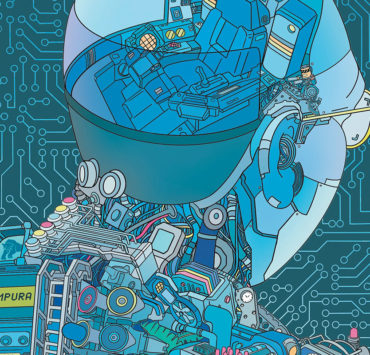





Following their popular series of anthologies featuring translated pulp fiction from Tamil Nadu, Blaft Publications’ latest release, The Blaft Anthology of Gujarati Pulp Fiction features delightful and eccentric short stories and novellas from Gujarat. Translated from Gujarati by Vishwambhari S. Parmar, the anthology preserves the local idioms and linguistic textures of the original stories without sacrificing clarity or nuance. Each story is also prefaced with a brief introduction to its original Gujarati author, thoughtfully acknowledging their work.

‘Bar Dancer’ by Vibhavari Verma is among the collection’s most memorable stories. It traces the journey of a bar dancer named Parvati, as she goes from using her dancing skills for the voyeuristic pleasure of men to discovering a measure of fulfilment and pride in her craft. Parvati falls for the charms of a customer who eventually abandons her, leaving her with a child. Left to raise the child alone, she works as a maid, struggling to make ends meet. When she unexpectedly finds herself cleaning the apartment of an acquaintance from her bar-dancing days, the past begins to circle back into her life. With the support of this friend and the encouragement of an unlikely ally, a dance teacher, Parvati begins to confront what was done to her, quietly resolving to humiliate the man who betrayed her.
What is refreshing about the story is that Parvati is not immediately cast as morally corrupt or depraved for being a bar dancer. Instead, we are shown the contours of her life: the dingy shed she calls home, her sick daughter for whom she cannot afford healthcare or schooling, the persistent pain in her leg, and the weary familiarity with sexual harassment that has become part of her daily reality. This is the story of a woman trying to get through each day without breaking under the weight of poverty and social shame. As these details accumulate, the reader develops a quiet camaraderie with her, sharing in the small, relentless perils of being a woman in these circumstances. The narrative does not shy away from speaking about sex work or the stigma attached to it.
Another story that stood out to me is H. N. Golibar’s ‘The Coils of Fate’. Its protagonist, Nilesh, is a journalist plagued by terrifying dreams in which he witnesses murders, dreams that begin to come true. The story opens with the killing of Seth Kailashnath. In his dream, Nilesh sees three men slip into the wealthy man’s house and murder him in his sleep. He wakes up shaken but relieved that it was only a dream. Yet when he goes to the bathroom to wash his face, he glimpses a strange face in the mirror, a face that’s gone the moment he blinks.
The following day brings the shock of his life. Nilesh learns that Seth Kailashnath has indeed been murdered, and to his horror he spots one of the killers walking down the street. He immediately turns to his friend, Inspector Chawla, for help in tracking down the murderers. What follows is a chain of seemingly random killings, each one first appearing in Nilesh’s dreams. As the story unfolds, Nilesh and the inspector find themselves racing against time, trying to prevent the next murder before the visions become reality.
The story creates a push and pull between the unfolding events and the reader’s trust in Nilesh’s account. Is he really telling the truth when he insists he knows nothing about the murders? How could mere dreams contain such precise details of the crimes? And what if he is not just a witness, but somehow aiding the murderer? As the story progresses, the evidence against Nilesh begins to pile up, making his innocence increasingly difficult to believe. Just when it seems he may be trying to pull the wool over the reader’s eyes, the narrative takes an unexpected turn, suggesting that Nilesh might, in fact, be possessed.
The anthology contains several more stories in a similar vein, with a lively blend of drama, anticipation, and just the right amount of masala to ignite the reader’s imagination and keep boredom at bay. Sensational and fast-paced, they are full of twists and turns that keep the reader hooked. Written in an easy, accessible language, these stories are perfect for moments when you want to switch off an overworked brain and simply be entertained. They offer a welcome respite from the routines of everyday life. In the most Indian sense of the phrase, they make for excellent time-pass, much like the dramatic T.V. serials that many of us watch, with their improbable twists and C.G.I. ghosts.
“Whether you’re in the mood for horror, scandal, superstition, sisterhood, or grisly murder, this book has it all.”
What I particularly enjoyed about these stories is that, despite their elements of fiction and suspense, they remain rooted in the lives of ordinary people and their everyday struggles. They touch on myths and superstitions, societal biases, and gender violence, but they also offer glimpses of hope and trust within communities, and the quiet strength of genuine friendship. I found myself drawn to the characters, wanting to connect with them and sympathise with the lives they represent.
Today, when smartphones have largely replaced paperbacks as our primary source of entertainment, we rarely encounter real, authentic people on our screens anymore. Instead, we are surrounded by influencers—or those aspiring to become them. In such a space, there’s very little that feels entirely genuine; everything is filmed, edited, and filtered. Most of what we see carries the suspicion of being sponsored or staged (or a scam), slowly making us wary of trusting anyone as we drift through this vast online void.
On algorithm-driven platforms, one gradually loses the pleasure of stumbling upon new and authentic stories. Watch one reel and the system quickly offers dozens more in the same format, often set to the same song, until you get sick of it in a few days. Algorithms push everyone to blend into the same mould of face and personality in order to gain their favour, while anything unique or “controversial” is quickly flattened or squashed.
The Blaft Anthology of Gujarati Pulp Fiction, by contrast, feels refreshingly unconcerned with such formulae. Its aim is not to gain the favour of the system but simply to catch the eye of a curious passerby who might pause at a bookshelf and pick it up. In doing so, it celebrates the distinct and diverse voices of its writers and the worlds they have created. The stories make room for a wide range of characters: men, women, ghosts, restless spirits, and more. They are not bound by seasons or passing trends, and whether you’re in the mood for horror, scandal, superstition, sisterhood, or grisly murder, this book has it all.
There is no competition here for the most views, nor is the book designed to keep you hooked for hours until your eyes burn out. One is free to put the anthology down and return to it weeks later, picking up another story when the mood strikes. Each piece feels distinct and just as engaging as the last. The stories may be short, but they are immersive in a way that reels are not. As a reader, you become a witness, invested in what happens next; the story does not merely happen to you while you lie in bed scrolling past it. Best of all, once you have the book, it is truly yours. There is no subscription fee to unlock the next story, and no uneasy sense of an algorithm or A.I. quietly watching over your shoulder.
Today, the way we pass our time looks very different from how it did even five or ten years ago. And so, in the spirit of a familiar Internet habit, here is my unsolicited advice: put down your phone and pick up a short story or two. Blaft’s inclusion of vivid magazine covers and artwork from the original publications might just be enticing enough to make that happen. Instead of passing time on social media, spend it reading pulp stories written by someone in Gujarat 50 years ago. After all, I hear that stepping away from social media is the new trend for this year. And if that sounds tempting, you might just want to begin by spending a quiet evening with one of these strange and delightful stories.