



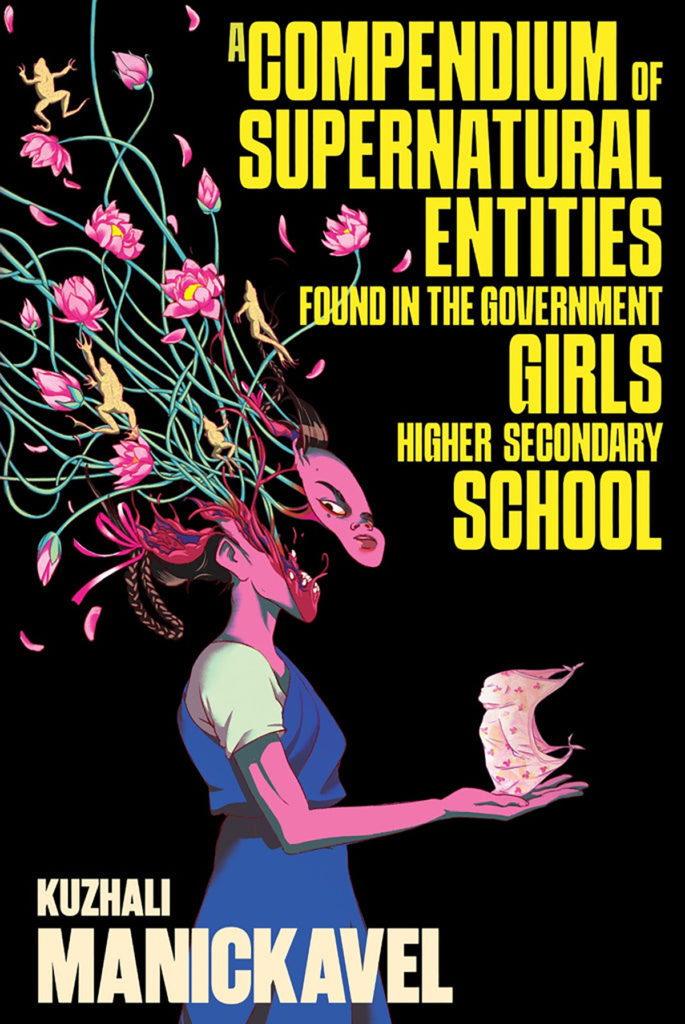
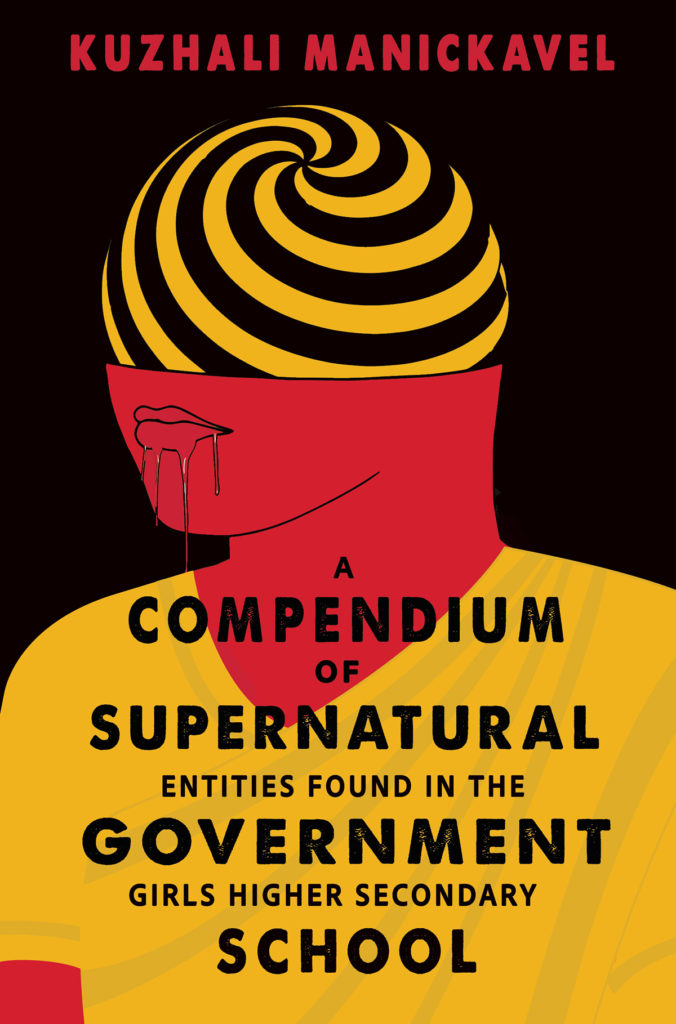
In the Government Girls Higher Secondary School, you might run into patriotic sandworms, phantom floors accidentally accessed by running up a flight of stairs, or Cine Heroes that lurk around corners and get girls to fall in love with them on sight. Or, more likely, you might not see any of these entities at all, and you might laugh if someone points them out to you. In Kuzhali Manickavel’s first full-length novel, A Compendium of Supernatural Entities Found in the Government Girls Higher Secondary School, we meet all these entities and more in a town in Tamil Nadu, where one girl—Thamarai—finds herself uniquely susceptible to the supernatural. For instance: one day, she “stumbled into a wall and remained stuck inside it for the whole afternoon”.
Compendium is a lot of things: a coming-of-age story, a school story, a horror story, and a completely unique way to look at the dreams, desires, and complexities of the lives of a group of schoolgirls in small-town India. Manickavel takes a setting that will be immediately recognisable to some readers and infuses it with her usual wit and weirdness. After years of writing short fiction, novellas, and zines, her first novel is a surprising, moving, and absorbing read.
We spoke with Kuzhali Manickavel about drawing from her experiences in a government girls school, writing the outsider, avoiding the obvious, and writing the kinds of stories she wants to read.
This is your first full-length novel. What kind of work did that take? Did you find the experience very different from writing the novellas or short stories you’ve written before?
It was a very different process, and I figured that out as I went along. The actual process of putting it down on paper took about a year, but I realised that I had been writing this novel in different ways for many years prior. I’ve been taking notes and thinking about the storyline, but I never had time to actually put it down until I took that year to write the novel.
[It was] very different from writing short stories. With short stories, it’s easier when you have a finite space to work in, but with a novel, the space is much bigger. I think with short stories, especially with flash fiction, the focus so much is on removing any word or sentence that isn’t needed, and paring it down to that crystallised form of whatever the story is. And I’m not saying that novels are the opposite of that, but you certainly did have to go about it a different way—the details in which you allowed the story to come through, as it were.With flash fiction, sometimes it feels like you’re capturing a feeling in a very short space. What was it like to chart an emotional arc across an entire book?
It involved taking a step back and trying to see the main character in an honest kind of way. When I say honest, I mean not putting an agenda or trying to alter the way the story arc is going.
I’d love to hear more about Thamarai as a character. One thing your book does so well is move between these different registers. There were moments that truly, truly scared me, these proper horror bits, and then others that were really funny, partly because I could recognise some of my own school experiences. But there’s also this undercurrent of melancholy or sadness throughout the book, especially around Thamarai. There’s a sense that she feels different, whether that’s because of her queerness, in whatever way she would describe it, or her realisation that the people around her are actually serious about “real life”. And then, of course, there’s her relationship with the supernatural, which nobody else seems to share. I’d really love to know more about Thamarai and this sense of melancholy and difference.
A lot of it was based on my own experiences going to a government school like that in Chidambaram. But I was also growing up with girls like that, who are largely invisible or ignored in the larger space—[it’s unusual for people] to be able to see what is important to them and how they’re navigating their lives in a very confined space. I found that endlessly interesting, but also very humbling as well. I think that when you look at a class of girls in a government girls school, it’s very easy to think that everyone looks the same, because of the uniforms, and the hair is done the same, and everyone has black hair. I always thought it was very interesting that underneath that layer of what looks like sameness, you have such diverse people. The fact that they are trying to be themselves in a confined space almost crystallises their individuality in a certain way.
With Thamarai, I wanted to investigate that a little bit more because I feel like especially with girls at that age in those kinds of areas, they’re either considered to be very studious or they’re focused on getting married, but there’s so much else happening and there’s often not room to sustain those other things that are happening. It can only happen in this small space. You’re aware that it can only happen here and it’s not going to be able to sustain itself through the rest of your life.
I was also very interested in the idea of the outsider. I don’t like using the term “outsider” because I feel like that’s something that people speak of in an aspirational way, like, you know, “I’m an outsider, I’m a rebel, I’m weird.” But I feel like there’s an aspect of that where it’s actually very lonely, being on the outside. It’s very isolating. Oftentimes with people who are on the outside, there’s this desire to be on the inside. You don’t want to be out there, because you’re looking at what’s happening on the inside almost all the time and it definitely looks better there. Being on the outside, or being different isn’t necessarily an empowering thing for everybody. I think in situations where it’s difficult to be an individual, then being on the outside is actually something you don’t want at all. You don’t want to appear different.
When I came to Chidambaram from Canada, one of the first things that I did was I tried my best to hide my Canadian accent. I picked up the local Tamil very quickly. I didn’t want to look different from anyone. I didn’t want to stick out in any way at all. So I think I wanted to explore those themes. I think we have a certain way of looking at queerness as being the story of the outsider, and in this case, it does deal with those themes, but I think it looks at them in a different way, considering that being on the outside has its own challenges. It’s probably coming from a place of privilege when you can be on the outside and say, “I love being on the outside. I love being weird.”
This book is published in India by Blaft, and I know it has an international release through Angry Robot as well. I get the sense from your writing, and I mean this as a total compliment, that you don’t think too much about the audience when you write. Your stories feel very much like themselves. I was wondering if that’s something you think about, especially with a novel that’s so rooted in the place it’s set?
I think at the beginning of my writing career, I tried very hard to be like everyone else, like the American and U.K. writers that were out there online in the different forums. I was very aware that my stories—the stories that I wanted to honestly tell—didn’t have any place there. People didn’t know how to view it. And when the stories you have don’t have a place in the audience or in the peer group that you’re in, it can be very discouraging. You can actually get the feeling that, “okay, maybe my story is wrong,” you know? “Maybe this is not something that I’m supposed to talk about, because no one else is talking about this.”
I tried and failed to be that American or U.K. writer. I tried very hard to dip into my Canadian roots and write something. But I think at one point I just got very annoyed by this whole process that didn’t have room for me or my stories. When they were welcoming or talking about Indian writers, it was a very specific kind of Indian writing, which I don’t do, which is not interesting for me. So if you didn’t conform to that, honestly, they had no place for you. And I found that actually very interesting to think about and look at later on in my writing career, because I feel that writing is very much an exercise in privilege. People who are writers are writers because they have the privilege to do that. They have the privilege to tell their stories. And it’s also a privilege to be in a space where your stories are welcomed or that people will even give them a chance.
So at some point I got fed up, and this is what I end up following now with my writing: I write things that I think are interesting, that I enjoy. When I look back and read the stories again, I enjoy reading them. But I’m also very aware that that doesn’t mean that other people are going to like it or that they’re going to be open to it or they’re going to understand it. I’m very aware that it’s a niche kind of thing, which is why I’m always delighted when I come across people who say that they enjoyed the work. I think that’s so amazing. I’m just writing stuff that I can relate to and that I understand. And I can’t expect other people to come from the same place.
“Being on the outside, or being different isn’t necessarily an empowering thing for everybody. I think in situations where it’s difficult to be an individual, then being on the outside is actually something you don’t want at all. You don’t want to appear different.”
Yeah, absolutely. And I think you can tell, especially as Indian readers, when you read something Indian and think, “I don’t know who you wrote this for, but it wasn’t me.”
Yeah. And I do want to say that when I first started writing out, it was like a barren wasteland. There was nothing out there really. And I think now there’s so many younger writers who are unafraid of writing about things that are interesting to them. And so that old mould of Indian stereotypical writing is slowly breaking, which I think is wonderful. I think that’s great.
Something I thought was so much fun in your book is the titular compendium. Entries from it appear throughout the book, describing these various supernatural entities that can be found on the school grounds. Sometimes you take very ordinary occurrences and make them supernatural, and other times you’re inventing these really wild things. The girl in her birthday-coloured dress who haunts the school was simultaneously so familiar and so scary. One scene with her genuinely terrified me. What was the process of creating these monsters like?
It was actually an interesting exercise for me, because when I came to Chidambaram from Canada, I was literally just scooped out of a junior high school and dumped into a government girls school. I had no idea what to expect. Everything was new and unfamiliar. The language, the way I had to dress, the festivals, the way that we were interacting as students. Even things at a very small level, like how we were writing in our notebooks, the pens. Suddenly we were using fountain pens. All of that was very alien to me. I couldn’t understand them. And one way to process that when I was writing the story was to attribute a supernatural element to that.
I think that is something that we do in life when we come across things that we don’t understand. They immediately become this great unknown. One set of stories that I did earlier [collected in Things We Found During The Autopsy] was set in a place called the Tropicool Icy-Land Urban Indian Slum, that also has these supernatural elements—there are talking fish and there are penguins that ride bicycles. I feel like that too came from this feeling that people that were not part of a slum ecosystem were writing about slums as if they knew what was going on there. When they try to do that, obviously there are things that they will not understand because they’re not from that kind of a space. And so there tends to be these shades of mystery, all these things take on a kind of mysterious hue. I feel like old weird fiction, the stuff that came out in the 1800s, was very much based in not understanding what the natives were doing and not understanding native lands. [Those ideas of] racism and of being scared of the unknown largely forms this really strong basis for weird fiction.
In terms of the school, I think that was just a way of understanding and sorting things out. Like with that birthday girl, I’ve come across girls like that, and I’m sure you have too, right? I mean, obviously they’re not eating your face, but they just won’t go away. You’ve made the mistake of interacting, and now you’re like, “Oh my God, why did I speak to this little thing in the first place?” Even the whole concept of coloured dress was something I couldn’t understand—the concept of wearing that on your birthday and then giving everybody chocolate, that was also something very new. So I think it was just a way to navigate all these things that I didn’t understand about my new living area.
“People who are writers are writers because they have the privilege to do that. They have the privilege to tell their stories. And it’s also a privilege to be in a space where your stories are welcomed or that people will even give them a chance.”
One of the things Compendium reminded me of, and this only occurred to me at the end, which I think says something about how singular the book felt, was a series I read as a kid called Wayside School. They’re books for children, set in a school, and they had these random, creepy moments. There was a teacher who would turn kids into apples, I think? And there’s a whole thing about a phantom floor, too, just like in Compendium.
Oh, wow.
I was wondering if there are books that influenced your writing when you were a kid, or if there were school stories that you thought about when you were writing this?
There are a few books which influenced me when I was young and I keep going back to them and looking at them. One is The Phantom Tollbooth by Norton Juster. Every time I look at it, it just blows my mind. It’s perfect in so many ways: the language play and the way that they handle this magical world, and yet when you look at it as a story and as a narrative, it’s actually so simple. It’s not a complicated story, really, at all. That’s a book that I often think about and I go back to.
Another one is called Behind the Attic Wall by Sylvia Cassedy. Without giving away too many spoilers, it’s about this misfit, a girl that keeps getting moved from girls school to girls school, who doesn’t really fit in. And then she is finally taken to one school where it looks very mysterious because she has this feeling she’s the only student there. She can’t find any other girls. And then one day she goes into the attic and she hears some people talking, and when she looks, it’s these dolls that are speaking to each other. It’s a little house that they are living in, in this corner of this attic. And the story is basically how she interacts with them and how that interaction changes her. That also has a lot of lovely language play, but that is a story I really love in terms of creating this space and immediately imbibing it with this magic, because when they’re describing that attic space, it really just sounds like an attic. But the minute the author starts to talk about these dolls and that corner, it completely changes, and this character’s trips to the attic suddenly become so different. It’s the same space and yet it has changed. I find that very interesting.
I’m very interested in space as almost as a character in stories and in books because I feel like each space holds something different for each person. And especially in rented spaces, spaces where people just come and go, they leave behind souvenirs, things on the wall, dents on the wall, in the paint. I feel like those are all stories. And so there’s all these stories which accumulate in these spaces.
I think with horror, or with genre fiction generally, there can be this tendency, as a reader, to look for a metaphor, or perhaps, as a writer, to write something that’s very clearly a metaphor, so that it maps neatly onto something in real life. I don’t think your writing does that at all. I find it interesting when you can read into something without it mapping perfectly onto a real-life equivalent, because I think that simplifies things too much. I was wondering if that’s something you consciously think about when you’re writing, whether to avoid it or lean into it.
It’s a good question. I haven’t thought about this, but now that you’ve asked it, I think when I’m writing and a very obvious metaphor presents itself, I try to move past that. Maybe this sounds snobbish, but I feel like obvious metaphors are lazy. You’re either using something you’ve already heard or read, or just what comes off the top of your head. But when you’re crafting a story, you really have to go past all of that in order to tell the story that only you can tell. And so that means that, if you take, say, a water bottle, only you can look at the water bottle in the way that you can. No one else can look at it the same way. So I feel like it is infinitely more interesting to delve deep and find out what your voice is in relation to that.
Obvious metaphors are obvious, and it’s maybe easier for people to read or understand, but I think you’d be surprised by people that will be able to relate to something that is very close to you and personal to you. Everyone looks at things so differently and that’s what makes everything so interesting, right? I really love to see that, and I’m very interested in hearing that. I think you see that more in children because they don’t have that inhibition yet. When my niece was younger, she would say the most magical things and I just love listening to her because she’s looking at things in such a fresh way which only she can see and only she can understand. So yeah, I’m not a fan of the usual metaphors. I think we can do better.